Article
Unintended Leadership
January 19, 2026
Most of the leadership mistakes I’ve seen didn’t come from bad intent.
They came from good intent that drifted.
Early in my career, I sat in countless boardrooms where the data screamed the same thing: we weren’t taking care of our customers. It was a clear problem to be solved. Naturally, as leaders, we’d shift into “crisis mode,” roll up our sleeves, and ask:
“What do we need to do differently to make them happy?”
We’d gather the feedback, look at the “brutal facts,” and set a goal. We’d decide to move the customer satisfaction score from X to Y. It’s a perfectly reasonable outcome metric—until it isn’t.
The trouble starts with how that goal travels through the organization. By the time it hits the front lines, the message has mutated. It shifts from “Improve the customer experience” to “Improve the number”.
We’ve all been on the receiving end of that shift — where it becomes painfully obvious the person serving you isn’t trying to improve your stay or your meal, they’re just trying to ‘check the box’ on a metric.
This is what I call Unintended Leadership.
Suddenly, your team isn’t focused on the person standing in front of them; they’re focused on making you happy. They’re obsessed with avoiding the “red number” on the dashboard because they’re paralyzed by the fear of missing the target.
Recently, one of our team members shared a photo from a hotel they were staying at. I’m sure it came from a good place. But the hotel had gone down that same road. Subtle reminders. Not-so-subtle reminders. Little nudges about how important the rating was.
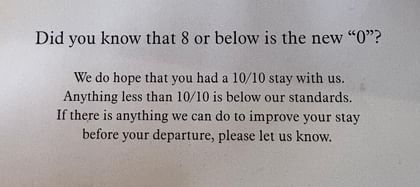
And instead of feeling taken care of, the guest felt pressured.
The Score is Just Smoke; The Feedback is the Fire
About a decade ago, while working with teams at the consulting firm Bain on a Net Promoter System implementation in one of my clients, I kept hearing the same warning: Don’t fall in love with the score.
The score is just an indicator. The real value is in the comments. The patterns. The stories that tell you what’s actually happening in the experience.
When leaders focus on the number instead of the signal, they teach the organization — without meaning to — that the number matters more than the customer.
That’s the real danger of unintended leadership.
Challenge:
- Where might your leadership have unintended consequences?
Additional Resources:
About Lawrence & Co.
Lawrence & Co. is a growth strategy and leadership advisory firm that helps mid-market companies achieve lasting, reliable growth. Our Growth Management System turns 30 years of experience into practical steps that drive clarity, alignment, and performance—so leaders can grow faster, with less friction, and greater confidence.
About Kevin Lawrence
Kevin Lawrence has spent three decades helping companies scale from tens of millions to hundreds of millions in revenue. He works side-by-side with CEOs and leadership teams across North America, the Middle East, Asia, Australia, and Europe, bringing real-world insights from hands-on experience. Kevin is the author of Your Oxygen Mask First, a book of 17 habits to help high-performing leaders grow sustainably while protecting their mental health and resilience. He also contributed to Scaling Up (Rockefeller Habits 2.0). Based in Vancouver, he leads Lawrence & Co, a boutique firm of growth advisors.