Article
"Top of the flywheel is stuck": The phrase that restarted Medix's organic growth
November 23, 2026
Listen to the Article (7:01)
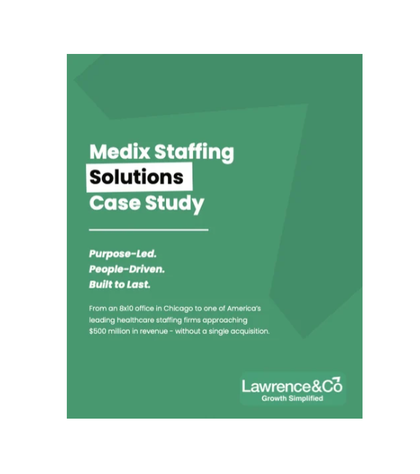
For three straight years, Medix Staffing Solutions hit the same revenue number. Profit was up, but growth had stalled. So Andrew Limouris and his executive team went offsite, mapped their flywheel, and found exactly where it was broken. The next year they grew $10M. From there, revenue went from roughly $161M to $253M, then past $400M. They haven’t looked back. This is the first article in a three-part series published alongside our new Medix case study.
For three straight years, Medix landed on the same top-line number. Give or take a couple million bucks, every single year.
Nothing looked broken. Profit was climbing. The team was executing well. Andrew Limouris, Medix’s founder and CEO, had built a disciplined company with a strong culture and a leadership team that almost never left.
The business was getting better. It just wasn’t getting bigger.
Unlocking the Flywheel (2:11)
I’ve worked with Andrew and his team for 15 years, and what happened next was one of the biggest turning points I’ve seen. (You can watch our full conversation here and read the Medix case study here.)
The stall that doesn’t feel like a stall
This kind of plateau is easy to live with. When profit is improving, there’s no crisis forcing a hard look. Every quarter feels like progress, and in a lot of ways it is.
In The 4 Forces of Growth, I define real growth as selling more X’s while sustaining your profit per X. Medix had the second half nailed. The first half had quietly stopped moving.
I see this all the time with mid-market CEOs. Smart team. Solid disciplines. Healthy margins. Flat revenue. The instinct is to push harder. That’s rarely the answer. The answer is finding where the machine is broken.
By year three, Andrew wanted that answer. So we went and got it.
Step one: Diagnose
We took the Medix executive team to St. Charles, Illinois, a small town just west of Chicago. An old hotel with fish in the creek out back. Nothing fancy, and that was the point. Your own boardroom is full of the same conversations you’ve been having for three years. A new room opens up your thinking.
Then we pulled out Jim Collins’ flywheel concept.
A strategic plan lists your priorities. A flywheel shows how the parts of your business feed each other. Each part drives the next, the loop comes back around, and the whole thing spins a little faster every turn.
The flip side is what matters most when you’re stuck. One weak part slows the entire flywheel. You can pour energy into the healthy parts all day and the wheel won’t go any faster.
So we built Medix’s flywheel together, stage by stage. Where does talent acquisition start? Where does client satisfaction feed referrals? Were we going after the right customers? Did we have enough accounts? Enough salespeople? Where exactly was it breaking?
There was plenty of debate. Andrew’s team argues hard and then lands together, which is exactly what this exercise needs. We didn’t get it perfect. We got it pretty damn close.
Doing it as a team is the key. A CEO who maps the flywheel alone gets a diagram. A leadership team that maps it together gets a shared strategy, and everyone leaves knowing which part of the wheel they own.
Step two: Reignite
After three flat years, Medix grew $10 million. Then revenue went from roughly $161 million to $253 million, then past $400 million.
To be clear, one day offsite didn’t do that work. Andrew’s team did, quarter after quarter, with the same planning discipline they’ve run for years. What the session gave them was aim. They stopped working on everything and fixed the one thing holding everything else back.
Step three: Never look back
The biggest payoff is that the flywheel never went back in the drawer. It became how Medix talks about its business.
In staffing, the top of the flywheel is talent. If you can’t attract and place great people, nothing downstream works. So when Andrew tells his head of HR the top of the wheel is stuck, no long explanation is needed. They both know exactly where to look.
That’s what keeps growth going. Your leaders can spot a bottleneck and fix it without waiting for the CEO to find it.
Today Medix is approaching half a billion dollars in revenue, built entirely organically, without a single acquisition. Those three flat years are a long way behind them.
How to map your own flywheel
A flywheel is not a process map. A process map is a sequence: we do step one, then step two, then step three. A flywheel is a transfer of energy. When one part happens, it can’t help but drive the next, the way a rock can’t help but fall to the ground.
- Take your leadership team offsite for a day. A new room helps.
- List the four to six components that drive growth in your business.
- Link them using the “can’t help but” test. For each link, ask: when this happens, does it can’t help but cause the next thing? For example, when clients get great talent, they can’t help but come back for more. If a link only says “and then we do this,” it’s a process step, not a flywheel. Keep going until the last component can’t help but power the first.
- Put real numbers on each component and find the one slowing the rest.
- Make fixing it your top priority for the next quarter.
- Use the flywheel’s language in every leadership meeting until it’s how your team thinks.
Challenge:
At your next quarterly planning session, draw your flywheel (Or if you already have one pressure test it to make sure it passes the “can’t help but” test) with your leadership team. Circle the one component slowing the rest, and make it your critical number or primary goal for the quarter.
Watch the full interview with Andrew below. (57:02)
Additional Resources
Articles
- 4 Fixes to Common Strategic Planning Mistakes
- The Ultimate Growth Lab May Be in Your Company
- If it Doesn’t Drive Your Flywheel, Just Say No
Growth CEO Interview
- Interview with Medix Founder, President & CEO, Andrew Limouris
- Interview with Bundaberg Brewed Drinks CEO, John McLean
Growth Case Studies
- Medix Staffing Solutions: Purpose-Led. People-Driven. Built to Last.
- The Little Potato Company: Lessons From a Natural Entrepreneur
Book: The 4 Forces of Growth
Book: Scaling Up
Book: Your Oxygen Mask First
About Andrew Limouris
Andrew Limouris is the founder, president, and CEO of Medix, a healthcare, life sciences, and technology staffing firm. He started it in December 2001 with six people in a small Chicago office, just months after 9⁄11, and grew it into a company approaching half a billion dollars in revenue that serves more than 1,500 client organizations. Medix got there entirely through organic growth, without a single acquisition. Andrew is a Midwest Ernst & Young Entrepreneur Of The Year and the author of Won With Purpose and Culture Through Crisis. Based in Chicago, he leads Medix around one simple purpose: positively impacting lives.
About Lawrence & Co.
Lawrence & Co. is a growth strategy and leadership advisory firm that helps mid-market companies achieve lasting, reliable growth. Our Growth Management System turns 30 years of experience into practical steps that drive clarity, alignment, and performance—so leaders can grow faster, with less friction, and greater confidence.
About Kevin Lawrence
Kevin Lawrence has spent three decades helping companies scale from tens of millions to hundreds of millions in revenue. He works side-by-side with CEOs and leadership teams across North America, the Middle East, Asia, Australia, and Europe, bringing real-world insights from hands-on experience. Kevin is the author of Your Oxygen Mask First, a book of 17 habits to help high-performing leaders grow sustainably while protecting their mental health and resilience. He also contributed to Scaling Up (Rockefeller Habits 2.0). Based in Vancouver, he leads Lawrence & Co, a boutique firm of growth advisors.